Healthcare
Network monitoring for clinics, built around what stays on site
Clinics and multi-site practices depend on the network for phones, printers, Wi-Fi and the servers behind them. Monitaria watches that infrastructure at every location from collectors on your own network.
It checks whether devices and services answer and how they perform. Support never needs patient information, and the support ticket form asks people to leave it out.
What it handles
- Network details shouldn't leave the clinic
- The collector keeps device addresses, hostnames, monitored URLs, SNMP communities and all history on the VM. A linked hub receives only a status snapshot, and a collector works fully on its own: organizations that send nothing offsite simply don't link a hub.
- A clinic's internet link goes down
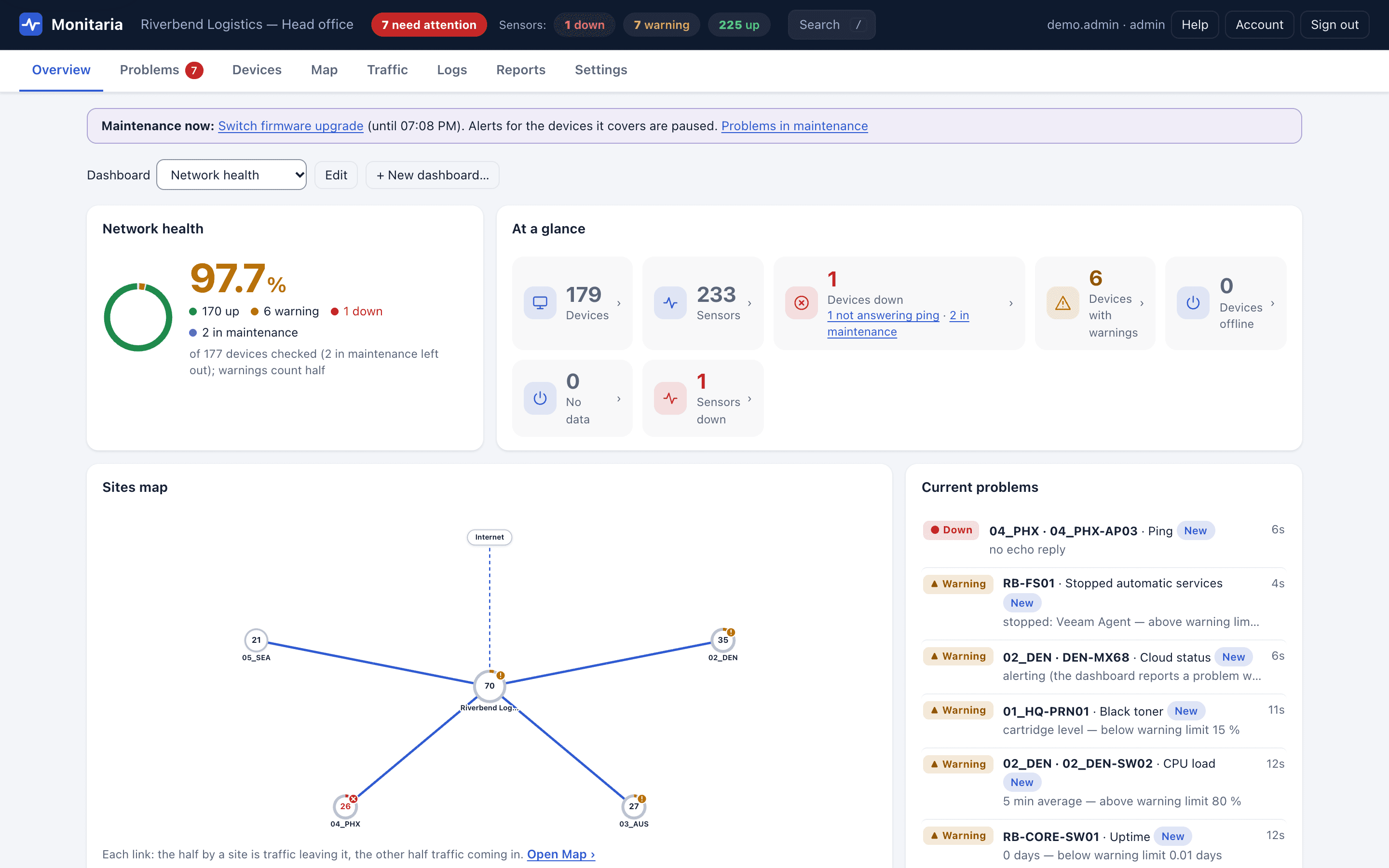
- Monitoring and history carry on at the site, and the collector's own dashboard stays reachable on the local network. With one collector for several clinics, a clinic whose router stops answering raises one problem for the router, not one per device.
- Front-desk printers, label printers and phones
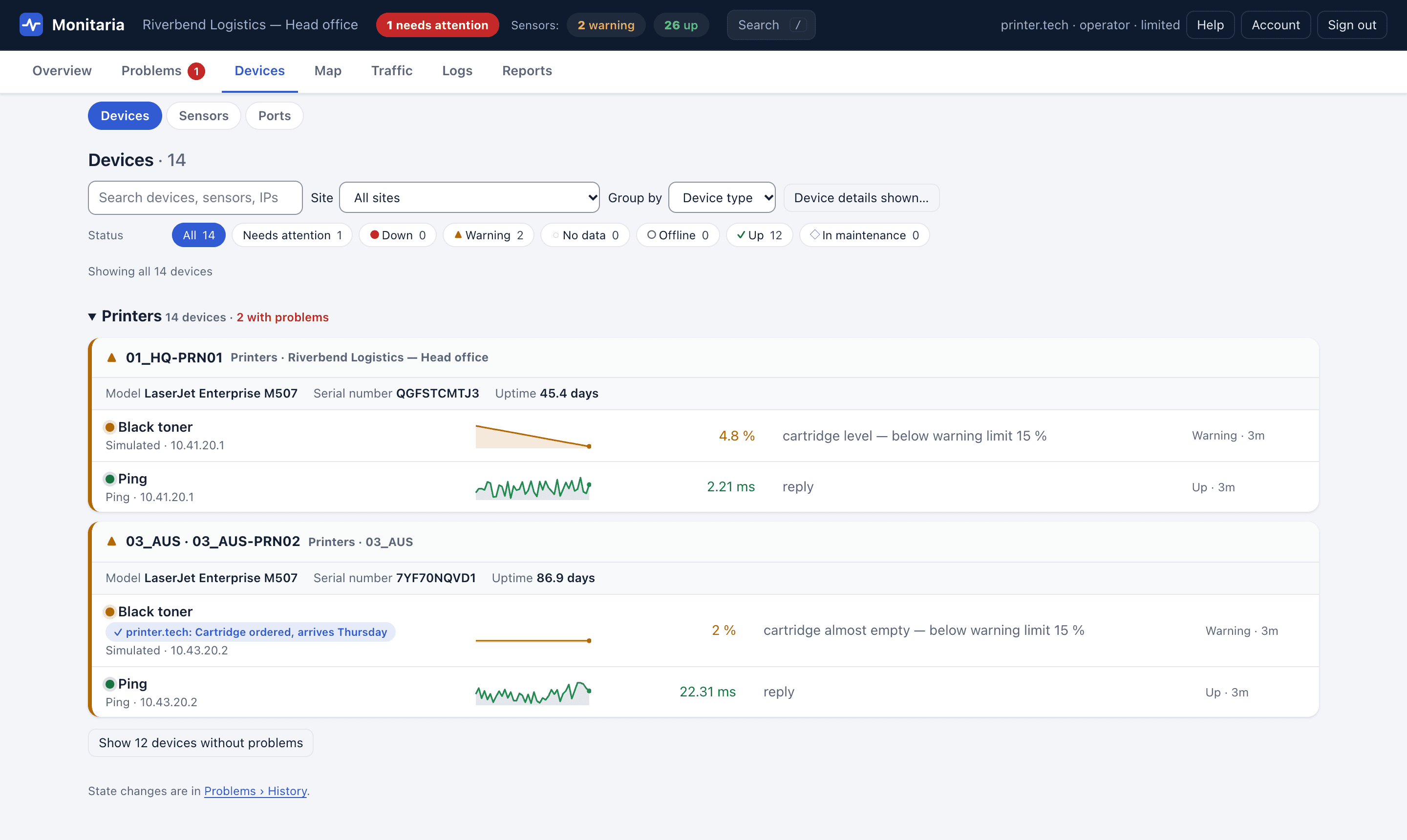
- Printers report status and toner levels over SNMP, IP phones are monitored like any device, and workstations that are switched off show as Offline rather than down, with no alert.
- Portals and certificates
- Website checks watch the portals and services the clinics rely on, with response time and required text, and certificate checks warn 21 days before a certificate expires.
- Monitoring that is itself reliable
- A high availability pair takes over in about 30 seconds if the primary collector stops. Every configuration change is validated and backed up, and licensing never stops monitoring or alerts.
What it looks like
How it connects
Customer network, at each site
- Routers and firewalls
- Switches and Wi-Fi
- Servers and UPS
- Printers, phones, cameras
- Computers and laptops
- Websites and services
Ping, TCP, HTTP(S), DNS, TLS, SNMP v1/v2c/v3, WinRM; NetFlow, sFlow, syslog and traps in
Local collector VM
- Checks every device and keeps the history in SQLite on the VM
- Raises alerts and serves its own dashboard on the local network
- Keeps monitoring when the internet link is down
Site firewall
Outbound HTTPS only
TCP 443 to the hub. A small status snapshot, signed with HMAC-SHA256, with replay protection.
Inbound: nothing
No firewall rules, no VPN, no port forwarding.
Hosted
Monitaria hub
- Every site's status on one dashboard
- Sign-in with Microsoft or Google work accounts
- Flags sites that stop reporting
- Only answers; never connects to a site
Optional: a collector also runs on its own, with no hub.
Also included
- Local accounts with scrypt-hashed passwords; two-factor sign-in required for admins on new collectors
- Access limited by site and device type, enforced on the server
- Audit log of sign-ins, failed attempts and every change
- HTTPS with your own certificate, installed from the web interface
- 20% off for nonprofits and community health centers
Try it on your own network
Every collector includes a 30-day evaluation with every feature, counted from the first time it starts. Monitoring and alerts never stop because of licensing.